Tokyo
Norwegian WoodTokyo is the novel’s central city of arrival, routine, encounter, and return: Toru Watanabe comes there as an eighteen-year-old student, builds a life among dormitories, railway lines, work, and crowded streets, and later retreats from it when grief overwhelms him. The city is not simply a backdrop to memory. Its routes and boundaries organize who can meet, where care can be sought, and how far a person can travel from the dead without escaping their hold.
Arrival and the Dormitory
Watanabe arrives in Tokyo at eighteen, a first-year student new both to the city and to living alone. His anxious parents choose a private dormitory because it provides meals and other facilities; it is also far cheaper than renting a room, an important consideration alongside university fees and tuition. Watanabe would have preferred a flat and comfortable solitude, but feels unable to insist, and admits that at the time he does not particularly care where he lives.
The dormitory occupies a hill in the middle of the city, inside a concrete-walled compound built around a large quadrangle. A towering zelkova stands just within the gate, said to be at least 150 years old; its dense canopy conceals the sky when seen from below. The paved path curves around the tree, then runs straight between two three-storey dormitory buildings. Their many windows and matching cream-coloured curtains make them seem like flats converted into jails, or jails converted into flats, though the buildings are clean and not dark. Radios sound through open windows, placing ordinary student life inside architecture that suggests confinement.
The compound extends beyond the dorms to a common building with a dining hall and bathrooms downstairs and an auditorium, meeting rooms, and guest rooms upstairs. A third dormitory stands beside it. Green lawns and rotating sprinklers fill the quadrangle; behind the common building are a field for baseball and football and six tennis courts. This self-contained arrangement offers the young newcomer food, facilities, and a ready-made social environment, while the wall and institutional scale give his new life a distinct boundary from the city outside.
Routes of Separation and Return
Tokyo’s railway network makes distance manageable without making it emotionally simple. After meeting Naoko again, Watanabe and she take the Yamanote Line before she changes to the Chuo Line at Shinjuku. She lives in a tiny flat in Kokubunji, far out in the western suburbs. Their parting is also a question about change: Naoko asks whether anything about the way she speaks has changed, and Watanabe can only answer uncertainly. The journey connects their meeting to the city’s periphery, while the conversation reveals how little either can confidently know about the other’s inner life.
When Watanabe receives a seven-page letter from Naoko at the dorm, he is afraid that remaining near it will lead him to reread it again and again. He puts it away, walks through Tokyo on a Sunday without a destination, and turns over its sentences in his mind, recalling the aimless walks he used to take with her. After sunset he returns to the dorm and calls the Ami Hostel to ask whether he may visit her the next afternoon. He later leaves Tokyo for the mountains, but his departure begins in the city with a letter, a solitary walk, and a telephone call.
The return journey makes the contrast with the hostel explicit. After leaving the mountain community, Watanabe feels that he has entered an outside world whose gravity is slightly different. Back in the dorm by 4:30, he changes and goes to his job at a record shop in Shinjuku, where he works from six until 10:30. He sells a few records but spends most of the shift dazed, watching a stream of people outside: families, couples, drunks, gangsters, girls in short skirts, hippies, and bar hostesses. Hard rock draws hippies and runaway children who dance or sniff paint thinner; Tony Bennett sends them away. The shop’s changing audience gives the city a public rhythm in sharp contrast to the mountain settlement’s controlled routine.
The Crowded City and Its Institutions
Tokyo’s streets expose Watanabe to lives he watches without joining. Near the record shop, a middle-aged man’s adult-toy store does brisk business; a student vomits in an alley, a restaurant cook plays bingo for cash in an arcade, and a homeless man crouches beneath the eaves of a closed shop. A girl no older than twelve or thirteen comes in asking for the Rolling Stones’ “Jumpin’ Jack Flash.” Watanabe plays it, gives her one of the manager’s cigarettes, and watches her dance before she leaves without thanking him. These encounters are concrete fragments of a city that continues to bustle around his private numbness.
The university hospital is another Tokyo institution, but here the city’s density is concentrated into a place of illness and anxious visitation. Its corridors are crowded and noisy on a weekend, filled with visitors and patients whose symptoms are less serious. Disinfectant, flowers, urine, and mattresses mingle in the hospital smell, while nurses move through the corridors with the dry clatter of their heels. Midori’s father lies in a semi-private room in the bed nearest the door, looking, to Watanabe, like a tiny creature with a fatal wound. The crowded public corridor leads to a small, exposed figure whose illness recalls the loss of Midori’s mother to a brain tumour less than two years earlier.
These settings place unlike forms of vulnerability within the same metropolitan landscape. The dormitory supplies shelter and routine; the record shop exposes Watanabe to the city’s transient public life; the hospital brings him face to face with the bodily crisis of someone close to Midori. Tokyo offers connections and services, but it cannot make illness or grief orderly. Its institutions can house, employ, transport, and treat people without resolving what they carry between those spaces.
Departure, Grief, and the City’s Return
After Naoko’s death, Watanabe’s relation to Tokyo becomes one of withdrawal and flight. Following a quiet funeral in Kobe at the end of August, he returns to Tokyo, tells his landlord he will be away and his restaurant employer that he will not come to work, and sends Midori a short note asking her to wait until he can speak. He spends three days in cinemas, seeing every new film in the city, then packs his rucksack, withdraws his savings, goes to Shinjuku Station, and boards the first express train he can find going out of town. The capital becomes a point of departure precisely because the routines that had once held him there are no longer bearable.
His travels have no stable itinerary. He moves by train, bus, or rides in lorries, sleeping in empty car parks, stations, parks, on riverbanks, and by the seashore. Sometimes people bring him food and mosquito coils; elsewhere he is driven out of parks. When his money runs low, he works as a labourer for a few days and then continues. He wants to fall asleep in towns he does not know, not to reach a particular destination. Once, he calls Midori because he needs to hear her voice, a brief line of contact running back toward the city from which he has fled.
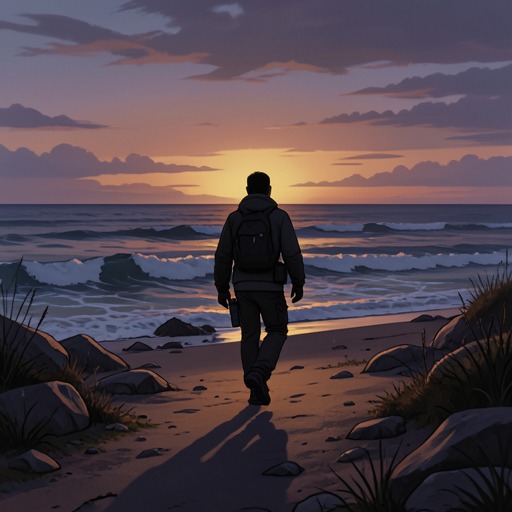
Far down the coast, perhaps in Tottori or on the hidden side of Hyogo, Watanabe walks by the sea, sleeps on sand, makes fires from driftwood, and roasts dried fish bought from a local fisherman. He drinks whisky and thinks about Naoko, unable to absorb that she is dead. Her image remains so vivid that physical memory seems to place her beside him, even as he knows that her body no longer exists. The distance he travels from Tokyo changes his surroundings, not the fact of loss.
When Watanabe later walks through Tokyo with Reiko, their quiet companionship makes the city a place of shared remembrance. He recognizes that the calm he feels beside her resembles the feeling he once had walking Tokyo with Naoko. In that earlier bond they shared the dead Kizuki; now Reiko and Watanabe share the dead Naoko. They speak of ordinary changes and past experiences but do not discuss her. Their silence is not an escape from memory: it marks a connection formed through it.
An early-autumn visit recalls the clear light of the year before, when Watanabe visited Naoko in Kyoto. The sharp light, high sky, flowers in the grass, and subtle reverberations of sound make the season’s return perceptible, while each cycle seems to increase the distance between him and the dead. Kizuki remains seventeen and Naoko twenty-one, fixed at the ages at which they died. Against that permanence, Tokyo’s changing streets and Watanabe’s repeated departures and returns register life continuing without making the past disappear.
Narrative Significance
Tokyo is built from contrasting kinds of enclosure. The dormitory’s wall and regimented buildings contain student life; the crowded city streets expose Watanabe to people whose lives pass close to his but remain largely unknown; the hospital corridors concentrate care and fear; and the railway stations open routes out. These are not interchangeable settings. Each gives a different shape to the distance between Watanabe and other people, from the protected but impersonal dormitory to the public streets where he watches others while remaining dazed and alone.
The city also anchors a narrative that moves between remembered scenes and their later consequences. Watanabe’s walks with Naoko in Tokyo, his solitary streets after reading her letter, his work in Shinjuku, and his departures after her death acquire meaning through recollection and return. The urban setting makes movement possible, but movement does not amount to recovery: the train out of Shinjuku carries him into an aimless journey, and later walks in the city bring the dead into relation with the living again. Tokyo’s decisive role is therefore not that it heals or confines him absolutely, but that it gives his changing life a network of places from which he can leave, to which he can return, and where memory continues to shape the present.